


Healthcare marketing leaders rely on accurate physician email lists to reach the right providers, reduce wasted spend, and support stronger healthcare lead generation. But when physician contact data becomes outdated, incomplete, or poorly verified, campaign performance drops fast.
A weak Physician Email Database affects more than email delivery. It damages sender reputation, increases bounce rates, reduces engagement, delays sales follow-up, and makes healthcare marketing teams question the quality of every lead source.
A physician email database is failing when bounce rates rise, job titles are outdated, segmentation is weak, contacts lack compliance signals, engagement drops, and sales teams cannot connect with the right physicians. Regular data quality assessment helps healthcare marketers identify these issues before campaigns lose ROI.
Below are the top signs your physician data needs attention before it hurts your next outreach campaign.
1. Your Bounce Rate Keeps Increasing

A rising bounce rate is one of the clearest signs that your physician email lists are no longer campaign-ready. Hard bounces usually mean the email address does not exist, the domain is inactive, or the physician has moved to another organization.
For healthcare marketing leaders, this creates two major problems. First, your message never reaches the intended physician. Second, repeated bounces can hurt sender reputation and reduce inbox placement for future campaigns.
A good physicians email list should go through frequent verification. It should remove inactive records, duplicate entries, invalid domains, and role-based addresses that do not support direct outreach.
A high bounce rate means your physician contact data is outdated or unverified. It reduces deliverability, wastes campaign budget, and weakens healthcare lead generation performance.
2. Physician Job Titles No Longer Match Reality

Physicians move between hospitals, private practices, academic centers, telehealth groups, and specialty clinics. If your physicians email database still shows old job titles or previous workplaces, your targeting becomes less accurate.
This issue becomes serious when your campaign depends on role-based targeting. For example, a healthcare software vendor may want to reach medical directors, department heads, practicing physicians, or specialists. If the title data is outdated, the campaign message reaches the wrong audience.
Strong physician data providers update physician job roles, workplace details, specialty information, and decision-maker signals on a consistent schedule.
3. Specialty Targeting Feels Too Broad

Poor segmentation often shows up when every physician record looks the same. A general physician database may include physicians across many specialties, but that does not mean it supports precise targeting.
Healthcare marketers need more than names and emails. They need specialty, subspecialty, location, practice type, NPI-linked data, hospital affiliation, clinic type, and communication fields. Without these details, every campaign becomes generic.
A campaign for cardiology equipment should not reach dermatologists. A campaign for orthopedic implants should not target general practitioners. A poor physicians database forces broad outreach, which lowers response rates and weakens brand trust.
Specialty targeting matters because physicians respond better to outreach that matches their clinical focus, practice setting, and buying needs.
4. Your Sales Team Cannot Trust the Data

A failing physician email database creates friction between marketing and sales. Marketing may report lead volume, but sales teams may complain that contacts are outdated, unreachable, irrelevant, or not decision-ready.
This is a common data quality assessment problem. If sales representatives spend too much time correcting records, finding phone numbers, checking LinkedIn profiles, or confirming physician workplaces, the database is slowing the pipeline instead of supporting it.
Clean physician contact data should help sales teams act faster. It should include usable fields such as email, phone number, specialty, organization, location, seniority, practice type, and other campaign-relevant attributes.
5. Email Engagement Is Dropping Campaign After Campaign
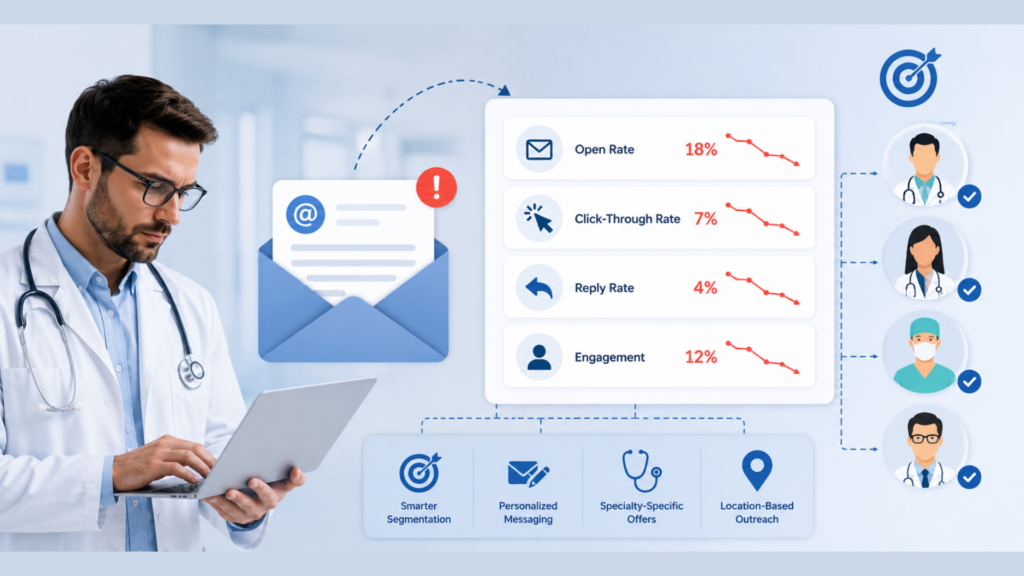
Low open rates, weak click-through rates, and poor reply rates often point to data quality issues. Sometimes the message is not the only problem. The real issue may be that the email list of physicians is no longer aligned with the campaign audience.
For example, a campaign promoting diagnostic tools needs contacts who influence diagnostic decisions. A campaign for practice management software may need private practice owners or operations-focused physician leaders. If your physician mailing list lacks these distinctions, engagement will suffer.
Healthcare marketing works best when the data supports personalization. Strong segmentation helps you create relevant subject lines, specialty-specific offers, and location-based outreach.
6. Your Database Has Too Many Missing Fields
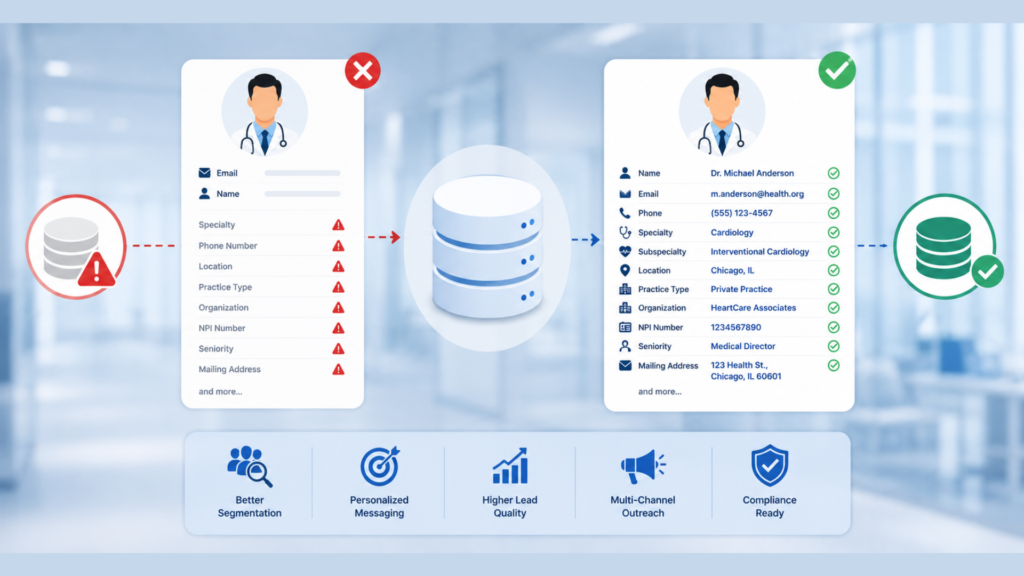
A physician record with only a name and email address gives marketing teams very little to work with. Missing fields reduce personalization, campaign segmentation, lead scoring, and account-based marketing accuracy.
A stronger physicians marketing list should include more than basic contact details. It should support filtering by specialty, location, organization type, practice setting, seniority, clinical focus, phone number, mailing address, and compliance-related data.
Missing fields also make multi-channel outreach harder. If your team wants to run email, calling, direct mail, LinkedIn ads, or event outreach, incomplete data limits every channel.
Missing data fields make physician outreach less targeted. Healthcare marketers need complete physician contact data to segment campaigns, personalize messaging, and improve lead quality.
7. Compliance Information Is Unclear
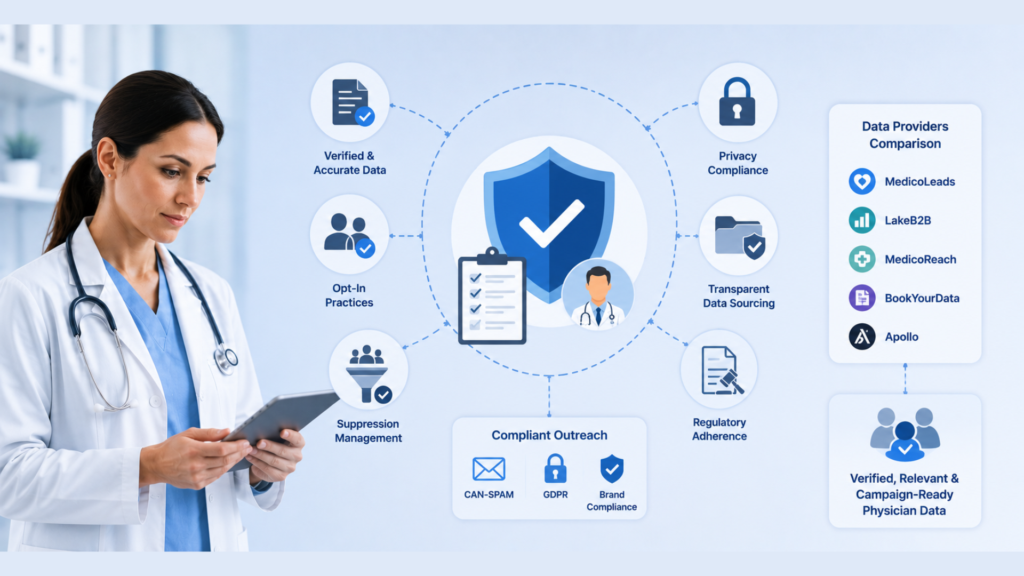
Healthcare marketing teams cannot afford unclear data sourcing. If a provider cannot explain how physician records are collected, verified, updated, and prepared for outreach, that is a serious warning sign.
Compliance does not mean every campaign is automatically risk-free. It means the data provider should support responsible outreach with opt-in practices, suppression management, regional privacy awareness, and clean documentation.
This is important when comparing healthcare data providers such as MedicoLeads, LakeB2B, MedicoReach, BookYourData and Apollo. The best choice is not always the largest list. It is the provider that offers verified, relevant, and campaign-ready physician contact data.
A quality physicians mailing list should help teams align with email marketing rules such as CAN-SPAM, GDPR where applicable, and internal brand compliance policies.
8. Your List Looks Large but Performs Small
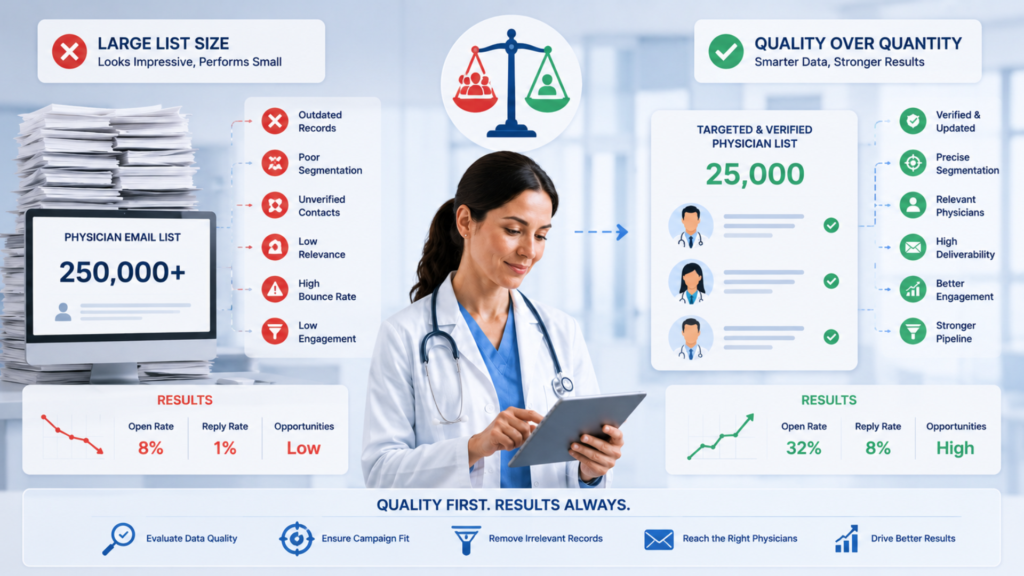
A large physicians email lists file may look impressive, but list size alone does not create pipeline. If only a small percentage of records are accurate, relevant, and reachable, your real campaign audience is much smaller than the database suggests.
This is where many healthcare lead generation campaigns fail. Teams buy large lists, upload them into an email platform, and expect fast results. But if the records are stale, poorly segmented, or not verified, campaign performance drops.
A better approach is to evaluate database quality before volume. Ask whether the list supports your exact campaign goal. Can it target physicians by location, specialty, organization, and decision-making role? Can it support email and direct outreach? Can it remove irrelevant records before launch?
A clean physicians mailing lists strategy focuses on fit, accuracy, deliverability, and campaign use cases.
How Poor Physician Contact Data Reduces Lead Generation ROI?
Poor physician contact data affects every stage of healthcare marketing. It weakens audience targeting, reduces email deliverability, lowers response rates, and creates more work for sales teams.
For healthcare marketing leaders, the cost is not only the price of the database. The larger cost comes from wasted ad spend, missed opportunities, damaged sender reputation, and inaccurate campaign reporting.
When a physician email database fails, teams often see:
- More bounced emails
- Lower open and reply rates
- Higher unsubscribe rates
- Weak lead quality
- Poor sales follow-up outcomes
- More time spent cleaning records
- Lower confidence in campaign reporting
- Slower pipeline growth
This is why data quality assessment should happen before every major physician outreach campaign.
What a Better Physician Database Should Include?
A strong physician database should give healthcare marketers the data needed to plan, segment, launch, and measure campaigns with confidence.
Look for a provider that offers:
- Verified physician emails
- Specialty and subspecialty filters
- Hospital, clinic, or practice details
- Location-based segmentation
- Phone numbers and mailing addresses
- Decision-maker and role indicators
- Regular data refresh cycles
- Compliance-aware sourcing and suppression support
A campaign-ready physicians list should not feel like a raw spreadsheet. It should function as a practical targeting asset for healthcare marketing, sales outreach, ABM, event promotion, and partnership development.
Why MedicoLeads Helps Healthcare Marketers Avoid These Data Gaps?
MedicoLeads helps healthcare marketers avoid common physician data gaps by focusing on accuracy, segmentation, compliance, and campaign usability. When databases fail because of bounces, outdated job titles, missing fields, broad targeting, or weak engagement, cleaner physician contact data gives teams a stronger starting point.
Each list goes through a 7+ tier verification process to reduce inactive emails, duplicate records, outdated contacts, and incomplete profiles. This supports 95%+ contact accuracy, 85% high email deliverability, and 100% opt-in contacts for safer, more focused outreach.
MedicoLeads also helps solve targeting issues by allowing teams to customize lists by job title, specialty, practice type, location, organization size, and purchasing authority. This helps healthcare marketers avoid generic campaigns and reach physicians who better match their offer, audience, and sales goals.
The data supports both inbound and outbound marketing. SMBs, mid-sized companies, and enterprises can use it for nurturing workflows, prospecting, CRM updates, calling, direct mail, paid audience building, and multi-channel marketing.
Customized contact lists can be delivered in CSV, XLS, JSON via API, or S3 Bucket delivery. Each file is organized with complete data attributes, helping teams reduce manual cleanup, improve campaign execution, support GDPR, CAN-SPAM, and HIPAA-aware outreach, and create better ROI from physician email lists.
Ready to Connect with the Right Healthcare Audience?
FAQs About Physician Email Lists
What are physician email lists?
How do I know if my Physician Email Database is outdated?
Your physician email database may be outdated if bounce rates rise, engagement drops, job titles look inaccurate, physician workplaces are incorrect, or sales teams cannot reach listed contacts.
Why does physician contact data quality matter?
Which is better Physicians Email Database or general B2B list?
A physicians email database focuses on healthcare-specific records, including specialties, practice types, hospital affiliations, and physician role details. A general B2B list may lack the medical context needed for healthcare campaigns.
Can a Physicians mailing List support direct mail campaigns?
Yes. A physicians mailing list can support direct mail when it includes verified mailing addresses, practice locations, and organization details. This helps marketers run email and offline outreach together.
Who uses a Physicians Marketing List?
A physicians marketing list is used by healthcare SaaS companies, medical device suppliers, pharma marketing teams, healthcare agencies, recruiters, event organizers, and B2B brands targeting physicians.
How often should physician email lists be updated?
physician email lists should be updated regularly because doctors change roles, practices, hospitals, and contact details. Frequent updates help reduce bounce rates and improve campaign performance.
What should I check before buying an email list of Physicians?
Conclusion
A failing physician database can quietly damage campaign performance before healthcare marketing leaders notice the full impact. Rising bounce rates, outdated job titles, weak segmentation, missing fields, unclear compliance, and low engagement all point to poor data quality.
The best physician email lists help teams reach the right physicians with accurate, segmented, and campaign-ready records. For healthcare brands focused on better targeting, stronger deliverability, and improved lead generation, data quality should come before list size.
MedicoLeads helps healthcare marketing teams build cleaner outreach campaigns with verified physician contact data designed for real B2B healthcare growth.