

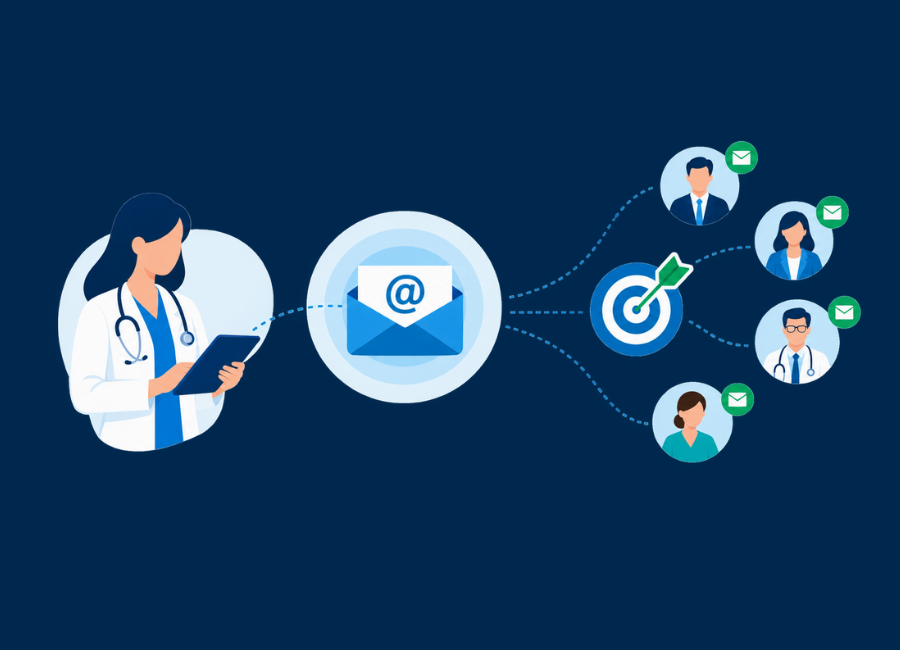
Healthcare is a difficult B2B audience to reach well. A cardiologist, a hospital materials manager and a health-system CIO sit inside the same industry, yet they buy different things and respond to different messages. Send one campaign to all of them and most of it lands on people who were never going to act.
A targeted medical email list solves a narrower problem than most vendors suggest. It does not write your message or build your pipeline. It defines who receives the message, using attributes such as specialty, role, organization type and location, so outreach reaches a defined audience instead of an industry label.
This guide covers what a medical email list contains, what you can target with one, and how to evaluate and use that data responsibly.
What Is a Medical Email List?
A medical email list is a structured database of business contact records for healthcare professionals and organizations, used for B2B outreach. Each record typically holds a professional email address, name, job title, specialty, organization and location, so teams can segment the audience and reach a defined group of healthcare contacts.
The data describes people in their professional capacity, not their patients. A useful record carries the attributes that make targeting possible: credential and role, specialty, practice or facility type, organization name, and geography down to ZIP code. Many also include direct phone numbers and organization size.
Segmentation is the point. A file with no reliable specialty or role data is a mailing list; one where you can isolate orthopedic surgeons in hospital-affiliated practices across three states is a targeting tool.
Why Use a Targeted Medical Email List for B2B Healthcare Outreach?
The advantage of targeted contact data is focus: you define the audience first and build the campaign around it.
- Audience targeting. Reach a defined group, not a broad industry segment.
- Specialty-based segmentation. Separate physician audiences by discipline, so a dermatology message never reaches a nephrologist.
- Geographic targeting. Match outreach to territories, service areas or regional launches.
- Role-based targeting. A device demonstration belongs with a surgeon; a contract conversation belongs with supply chain.
- Personalized messaging. Specialty, role and facility type give you details to write against.
- Campaign efficiency. A smaller, well-defined audience costs less and produces cleaner results.
- Lead generation. Content offers and trials reach people whose role makes them plausible buyers.
- Account-based outreach. Cover the clinical champion, technical evaluator and approver at one health system together.
None of this compensates for a weak offer. Targeting decides who hears you; the message decides whether they respond.

Who Can Use a Medical Email List?
Any organization that sells to, recruits from or educates healthcare professionals can use targeted contact data. Only the segment changes.
- Pharmaceutical companies reaching prescribers by specialty for education and medical-affairs work.
- Medical device companies targeting clinicians who use a device and the procurement roles that approve it.
- Healthcare technology companies promoting clinical software to IT and informatics leaders.
- Medical suppliers reaching purchasing managers and hospital decision-makers.
- Healthcare service providers in billing, coding and staffing marketing to practice management.
- Healthcare marketing agencies building campaigns for a specific clinical audience.
- Research organizations recruiting investigators, sites and specialists.
- Healthcare SaaS companies running demand generation against defined role segments.
What Can You Target With a Medical Email List?
Criteria vary by provider and by record, but most healthcare contact databases support some combination of the following. Layering two or three turns a broad file into a workable segment.
| Targeting Criteria | Example |
|---|---|
|
Medical Specialty |
Cardiologists, dentists, dermatologists |
|
Professional Role |
Physicians, pharmacists, nurses |
|
Geography |
Country, state, city, ZIP code |
|
Practice Type |
Private practice, hospital, clinic |
|
Organization |
Healthcare systems, medical facilities |
|
Business Attributes |
Organization size, specialty, location |
Attribute coverage is rarely uniform, so a sample built to your criteria says more than a list of filters.
Common Challenges With Healthcare Outreach
Most disappointing healthcare campaigns fail for reasons unrelated to creative quality.
- Broad, poorly segmented audiences. One message written for “healthcare” convinces almost nobody in it.
- Outdated contact information. Clinicians change practices and titles shift, so records decay continuously.
- Generic messaging. Copy that fits any industry reads as vendor noise.
- Incomplete professional data. Missing specialty or facility type removes the fields segmentation needs.
- Poor targeting. A procurement message sent to a clinical user wastes a contact you may only get once.
- Compliance considerations. Commercial email is regulated, and rules differ by jurisdiction.
- Lack of personalization. A first name is not personalization; relevance to specialty and role is.
These problems compound, as covered in this look at how data accuracy affects B2B results.
How to Evaluate a Medical Email List
Providers describe their data in similar language, so evaluate evidence rather than claims. Request a sample built to your criteria and check it against the following.
- Data accuracy. How it is defined, how it is measured, and what happens to records that fail.
- Email validity. Whether addresses are validated or guessed from a name and domain.
- Verification process. What is automated, what a person checks, how often each runs.
- Data freshness. The revalidation cycle, and when your segment was last checked.
- Opt-in and consent information. What permission status records carry, and how it was obtained.
- Available data attributes. Which fields are populated for your segment, not database-wide.
- Geographic coverage. Depth in the states or metros you sell into.
- Specialty coverage. Whether the specialties you need are genuinely represented.
- Custom segmentation. Whether a segment can be built to a written brief, or only from preset filters.
- CRM compatibility. Whether the export imports cleanly and deduplicates against records you hold.
- Compliance documentation. Sourcing detail and terms covering permitted use.
Two checks beat any specification sheet. Verify a few physician records against the NPPES registry maintained by CMS, which publishes FOIA-disclosable National Provider Identifier data, and run a small seed campaign first. Our guide to choosing a healthcare contact data provider covers this in full.
Best Practices for Using Medical Contact Data
- Define the audience. Write down specialty, role, facility type and geography before requesting data.
- Segment contacts. Split the file by attributes that change the message, not by every attribute available.
- Personalize campaigns. Write to the recipient’s clinical or operational context, not around merge tags.
- Verify requirements. Check legal and internal requirements for each region before launch.
- Use relevant messaging. Clinicians read for evidence and outcomes; administrators for cost, workflow and risk.
- Monitor engagement. Track bounces, opens, clicks and replies by segment.
- Maintain data hygiene. Suppress bounces and opt-outs immediately and revalidate on a schedule, as in this healthcare contact data hygiene process.
- Follow email and privacy requirements. Treat compliance as part of setup, not a final review step.
Using Healthcare Contact Data Responsibly
In the United States, the FTC’s CAN-SPAM compliance guide sets the requirements for commercial email: accurate headers, a non-deceptive subject line, identification as an advertisement, a valid postal address, and a working opt-out. The FTC states the law makes no exception for business-to-business email, so outreach to clinicians and hospital executives is covered.
HIPAA is widely misunderstood here. The US Department of Health and Human Services explains that the HIPAA Rules apply to covered entities and business associates handling protected health information. Marketing to a clinician as a business contact involves no patient data, so it generally falls outside HIPAA’s scope.
For UK and EU contacts, professional details still count as personal data. The ICO’s guidance on B2B marketing separates corporate subscribers from individual subscribers such as sole traders, who require consent or a soft opt-in. Independent practices often fall into that group. Our overview of data compliance in B2B marketing goes further. This is general information, not legal advice.
Examples of B2B Healthcare Outreach Campaigns
These are illustrative campaign structures, not reported customer results.
- Medical software launch. Segment by facility type and informatics role, then send a workflow-focused announcement with a demo offer.
- Medical device promotion. Target one surgical specialty in defined territories, lead with clinical evidence, and run a parallel supply-chain track.
- Conference outreach. Filter by specialty and region before an event, then follow up with attendees separately.
- Pharmaceutical education campaign. Reach prescribers in a therapeutic area with a CME offer, keeping content educational rather than promotional.
- Healthcare SaaS lead generation. Segment by organization size and administrative role, then nurture to a free trial.
- Medical supplier outreach. Target purchasing managers and practice administrators by facility type with contract-renewal messaging.
Sequencing and measurement are covered in our healthcare email marketing guide.
How MedicoLeads Supports Targeted Healthcare Outreach
MedicoLeads is a healthcare-focused contact data provider rather than a general business database with a healthcare filter. It covers healthcare professionals, executives and organizations, segmented by specialty, role, department, facility type and geography, across the US, UK, Europe, Australia and Singapore.
- 14M+ verified healthcare contacts across professionals, executives and organizations
- 40+ contact and firmographic data attributes
- A 7-tier verification process combining automated checks with manual validation
- Records revalidated on a 45-day cycle
- 100% opt-in business contacts
- Custom segmentation built to a written brief, delivered in CRM-ready formats
Attribute availability varies by record and segment, so a sample built to your criteria says more than a specification sheet. Request a sample, contact sales, or have a custom healthcare database built to your requirements.
FAQs
What is a medical email list?
A medical email list is a database of business contact records for healthcare professionals and organizations. Records typically include a professional email address, name, job title, specialty, organization and location, letting B2B teams target outreach by role, specialty or geography.
How can a medical email list support B2B healthcare marketing?
It defines who receives your campaign. Specialty, role, facility type and location let teams match each message to a specific audience, split clinical and procurement tracks, and measure results by segment.
Who can use a healthcare email list?
Pharmaceutical companies, medical device manufacturers, healthcare technology and SaaS firms, medical suppliers, service providers, staffing agencies, research organizations and marketing agencies. What differs is the segment, not the underlying data.
What information should a medical contact database contain?
At minimum a validated professional email address, name, job title and organization. A database useful for targeting also carries specialty, credential or role, practice or facility type, and geography to ZIP level. Phone numbers and organization size add precision.
How do I evaluate the quality of a medical email list?
Request a sample built to your criteria rather than a generic extract. Check field completeness, ask how accuracy is measured and how often records are revalidated, confirm permission status, verify a few physician records against the public NPPES registry, and run a seed campaign first.
Can medical email lists be segmented by specialty and location?
Yes. Specialty and geography are the most widely supported criteria, and most providers combine them with role, practice type and organization attributes. Coverage depth varies, so confirm your specialties and regions are well populated before buying.
How should healthcare contact data be used responsibly?
Follow the commercial email rules where you send. In the US, CAN-SPAM requires accurate headers, clear identification, a valid postal address and a working opt-out, with no B2B exemption. In the UK and EU, professional details remain personal data. Suppress opt-outs immediately.
How can I get a targeted medical email list?
Write down the specialty, role, facility type and geography you need, then ask providers to quote against that brief. Request a sample built to those criteria, test on a seed segment, and confirm the export works with your CRM.