

Healthcare lead generation in 2026 is a multi-step process that turns a raw contact record into a genuine sales opportunity. This guide walks through how that process actually works for B2B marketers, sales teams, recruiters, and healthcare technology vendors, and where a verified contact database like MedicoLeads fits into it.
What Is Healthcare Lead Generation?
Healthcare lead generation, in a B2B context, is the process of identifying, reaching, and engaging healthcare professionals, executives, and facilities who could plausibly buy or influence the purchase of a product or service. This is distinct from patient-facing marketing. A hospital IT vendor trying to reach a chief information officer, a medical device company targeting surgeons, a recruiting firm sourcing nurse practitioners, and a pharma company mapping specialists for a conference invite are all doing B2B healthcare lead generation, not marketing to patients.
The goal is not simply to collect names. It is to build a pipeline of contacts who move, through deliberate steps, from being unaware of a company to being ready for a sales conversation. Lead generation in this sense is a process with stages, not a single transaction. A contact list, an outbound email sequence, a webinar sign-up form, and a CRM workflow are all pieces of that process, but none of them alone constitutes lead generation. It is the combination of accurate targeting, relevant messaging, and consistent follow-up that turns raw contact information into a qualified opportunity.
Database Contact vs Prospect vs MQL vs SQL vs Opportunity vs Customer
One of the most common sources of confusion in B2B healthcare marketing is treating every name in a database as a lead. These are different stages, and conflating them leads to unrealistic expectations. Here is how each term is generally understood.
| Stage | What It Means |
|---|---|
|
Database Contact |
A record with name, title, specialty, and contact details. No engagement or relationship yet. |
|
Prospect |
A contact identified as a plausible fit based on role, specialty, or facility type tied to an ICP. |
|
MQL (Marketing-Qualified Lead) |
A prospect who took an action signaling interest, such as downloading a resource or attending a webinar. |
|
SQL (Sales-Qualified Lead) |
An MQL that sales has reviewed and accepted as worth pursuing directly. |
|
Opportunity |
An SQL in an active sales process, such as a demo or proposal, tracked in a CRM pipeline. |
|
Customer |
An opportunity that has converted into a signed contract or completed purchase. |
Understanding this progression matters because a database contact is many steps removed from a customer. Assuming contact volume alone predicts revenue is one of the most common mistakes in healthcare B2B marketing.
How Does Healthcare Lead Generation Work in 2026?
In 2026, the mechanics of healthcare lead generation are shaped by more channels, more data sources, and a more informed buyer than in previous years. Healthcare professionals and administrators are used to being marketed to, and tend to respond better to relevant, well-targeted outreach than to generic campaigns. The overall process follows a recognizable sequence: define who you are trying to reach, identify the right contacts, decide how to reach them, qualify their interest, nurture the relationship, and hand off to sales when the timing is right.

Defining Your Ideal Customer Profile (ICP)
Before any outreach happens, most effective healthcare marketing teams define an ideal customer profile. This typically includes the type of facility, such as a hospital system, ambulatory clinic, long-term care operator, dental practice, or pharmacy chain, along with the relevant specialties or departments and the roles most likely to have influence or authority over a purchase decision. A clearly defined ICP prevents wasted outreach and helps focus data sourcing and messaging on contacts who are actually likely to be relevant.
Identifying Decision-Makers
Healthcare organizations often have layered decision-making structures. A purchase might involve a department head, a procurement contact, an administrator, and sometimes a physician or clinical champion. Identifying the right mix of decision-makers and influencers, rather than a single title, is often necessary for B2B healthcare campaigns to gain traction. Resources such as this overview of healthcare executive contacts can help map who typically holds purchasing authority.
Sourcing and Segmenting Healthcare Data
Once an ICP and decision-maker map are in place, marketers need contact data reflecting those criteria. A healthcare contact database is useful here as a sourcing tool. Data quality and verification matter, not because any provider can guarantee perfect accuracy, but because outdated or poorly segmented data wastes outreach effort and can hurt sender reputation. Segmenting contacts by specialty, facility type, geography, or role, whether that means physicians, nurses, dentists, or hospital administrators, supports more relevant messaging later in the process.
Inbound vs Outbound Channels
Healthcare B2B lead generation generally relies on a mix of inbound and outbound methods. Inbound methods include content marketing, search visibility, webinars, and gated resources that attract healthcare professionals already researching a topic. Outbound methods include targeted email outreach, phone or virtual detailing, direct mail, and account-based advertising aimed at contacts identified through data sourcing and segmentation. Most mature programs use both, coordinating them so outbound outreach reinforces content a prospect might also see through inbound channels.
Lead Qualification and Scoring
Not every prospect who engages is equally ready to buy. Lead scoring assigns value to specific behaviors and attributes, such as job title, facility type, content engagement, or website activity, so marketing and sales teams can prioritize follow-up. Scoring thresholds are typically set collaboratively by marketing and sales so only prospects meeting agreed criteria are passed along as MQLs or SQLs, reducing the risk of sales teams chasing unqualified contacts.
Nurturing and CRM Workflows
Most healthcare prospects do not convert on first contact. Nurturing is a sequence of follow-up communications, such as email drip campaigns, retargeting, or personalized outreach, designed to keep a prospect engaged until they are ready for a sales conversation. CRM platforms are typically used to track this activity, log engagement history, and automate parts of the nurture sequence based on triggers like content downloads or email opens.
Measuring Engagement
Engagement measurement usually looks at signals such as email open and click rates, website visit frequency, content downloads, event attendance, and response to outreach. These signals feed into lead scoring and help marketing teams understand which segments, messages, or channels are performing well. Engagement metrics are a leading indicator of interest, not a guarantee of purchase.
Sales Handoff
When a prospect meets the agreed criteria for an SQL, marketing typically hands the contact to a sales representative, along with context on prior engagement, role, and any specific interests expressed. A clean handoff includes a clear record of what content the prospect engaged with and why they were qualified, so sales can pick up the conversation without starting from zero.
Healthcare Lead Generation Funnel in 2026
Thinking of healthcare lead generation as a funnel helps clarify why volume at the top does not translate directly into revenue at the bottom. Each stage narrows the pool, and each stage requires different work from marketing and sales teams.
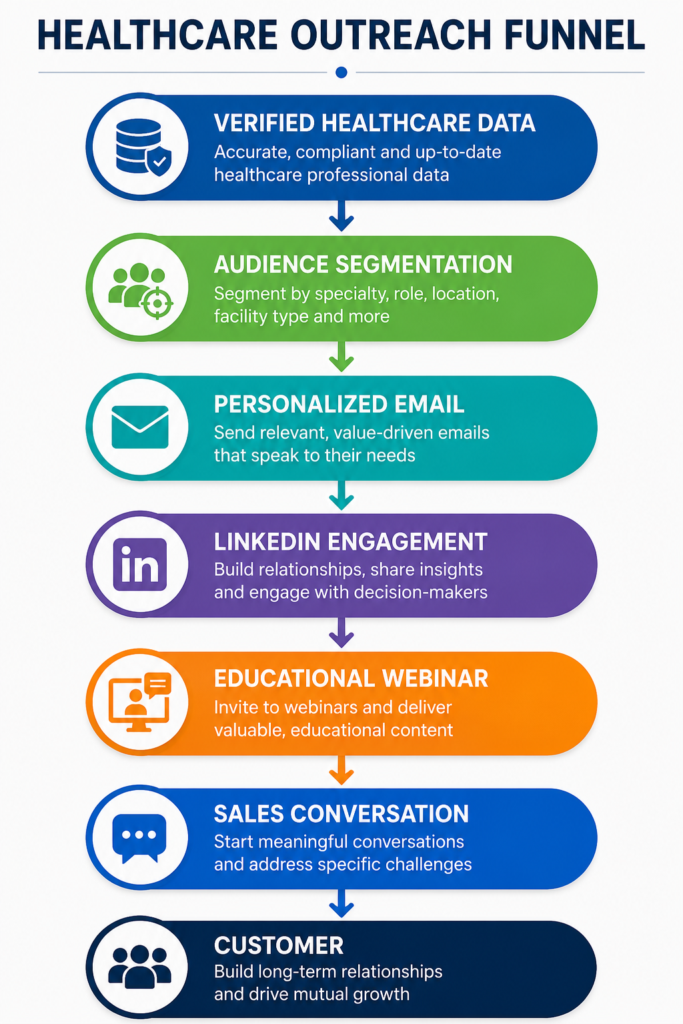
At the top of the funnel is awareness and audience building, where a broad set of database contacts and prospects, sourced and segmented according to an ICP, are exposed to a company through content, ads, or initial outreach. Most contacts at this stage have no established relationship with the company yet.
The next stage is engagement. Some portion of the audience responds by opening emails, visiting a website, downloading a resource, or attending a webinar, generating the behavioral signals that feed into lead scoring. From engagement, a smaller subset becomes MQLs, meeting whatever threshold marketing has defined. An even smaller subset is then reviewed and accepted by sales as SQLs, based on stronger signals of intent or fit. SQLs that enter an active sales process become opportunities, tracked in a CRM pipeline with defined next steps. Finally, a portion of opportunities close as customers.
Each narrowing at every stage is expected and normal. A healthy funnel does not aim to convert every contact into a customer; it aims to move the right prospects through each stage efficiently, while continuously refreshing the top with well-targeted new contacts so the pipeline does not stall. For more on how data quality affects this process, see how verified data addresses common healthcare lead generation issues.

Answer Engine Optimization (AEO), Generative Engine Optimization (GEO), and AI Overviews in Healthcare Marketing
Search behavior for B2B healthcare buyers has changed alongside broader shifts in how search engines present information. Many industry observers note that AI-generated overviews, featured snippets, and ‘people also ask’ panels are increasingly shaping how healthcare marketing content is discovered, sometimes answering a searcher’s question directly on the results page rather than sending them to a website.
Answer engine optimization generally refers to writing content that directly and clearly answers specific questions, using formats such as definitions, numbered steps, and comparison tables that are easy for search systems to extract and summarize. Generative engine optimization extends this idea to AI systems that synthesize answers from multiple sources rather than linking to a single page, placing more weight on being cited as a credible, well-structured source than on ranking first in a traditional list of links.
For healthcare B2B content, this generally means favoring clear terminology, defining terms like MQL or ICP rather than assuming familiarity, organizing content with descriptive headings, and directly answering the questions a buyer is likely to type into a search bar. Semantic search, which focuses on the meaning behind a query rather than exact keyword matches, also rewards content that covers a topic thoroughly rather than narrowly targeting one phrase.
Compliance Considerations in Healthcare B2B Marketing
Healthcare B2B marketers operate under a patchwork of data privacy and communication laws that vary by jurisdiction. This section is a general informational overview only and is not legal advice; marketers should consult qualified legal counsel about their specific obligations. More detail on this topic is available in this overview of data compliance in B2B marketing.
In the United States, the CAN-SPAM Act sets requirements for commercial email, including accurate sender information, clear subject lines, and a functional opt-out mechanism. State-level privacy laws, such as the California Consumer Privacy Act and its amendment the California Privacy Rights Act, give individuals certain rights over how their personal information is collected and used. Outside the United States, the General Data Protection Regulation in the European Union imposes stricter requirements around consent, data minimization, and individual rights for personal data tied to EU residents. Canada’s Anti-Spam Legislation, known as CASL, has its own consent and disclosure rules for electronic messages sent to Canadian recipients, and Australia’s framework under the Australian Communications and Media Authority governs commercial electronic messaging in a similar way.
Because healthcare contact data often involves professional rather than patient information, applicable rules can differ from those governing clinical data, but marketers should not assume professional B2B contact data is automatically exempt from privacy or anti-spam obligations. No data provider or marketing platform can be described as broadly compliant in the abstract, since compliance depends on how data is used and under which jurisdiction’s rules apply to a specific campaign.
How MedicoLeads Supports Healthcare Prospecting
MedicoLeads provides B2B contact data covering healthcare professionals and facilities, including physicians, nurses, dentists, pharmacists, surgeons, executives, and administrative contacts, intended to support prospecting and audience-building for marketers, sales teams, recruiters, healthcare technology vendors, and agencies. The role of this data is to give teams a starting point: a segmented set of contacts aligned with an ICP, so outbound and inbound campaigns can be built around a relevant audience rather than a generic one.
It is important to be direct about what contact data does and does not do. Purchasing or using a contact database does not automatically generate leads, revenue, or customers, and it does not make every contact a qualified lead. A database contact becomes a prospect through targeting, an MQL through engagement, an SQL through qualification, an opportunity through active sales work, and a customer only after that process plays out. MedicoLeads functions as one input into that process, supporting the sourcing and segmentation stage described earlier in this guide.
Related Resources
Frequently Asked Questions
What is a healthcare MQL?
A healthcare MQL, or marketing-qualified lead, is a prospect who has taken an action signaling interest, such as downloading a resource, registering for a webinar, or repeatedly visiting a website. It is a marketing-side qualification based on defined behavioral or role criteria, not yet a confirmation that a sale is likely. Sales teams typically review MQLs before deciding whether to pursue them further as SQLs.
Is a healthcare contact database the same thing as a list of leads?
No. A contact database is a set of records, such as names, titles, and contact details, that have not been engaged or qualified. It becomes useful for lead generation only once those contacts are segmented against an ideal customer profile and moved through outreach, engagement, and qualification steps.
How should a marketing team evaluate a healthcare data provider?
Useful factors include how the data is sourced and segmented, whether it supports the specialties, roles, and facility types relevant to your ICP, and how the provider describes its data practices. It is reasonable to ask providers general questions about their data collection and update practices, while keeping in mind that no provider can guarantee specific accuracy levels for every record over time.
Can buying a healthcare contact database guarantee sales results?
No. Purchasing or using a contact database does not automatically generate leads, revenue, or customers. It provides a starting set of prospects that still needs to move through targeting, outreach, engagement, qualification, nurturing, and a sales process before any revenue is realized.
What is the difference between inbound and outbound healthcare lead generation?
Inbound relies on content, search visibility, and gated resources that attract healthcare professionals already researching a topic. Outbound relies on proactive outreach, such as targeted email, calls, or account-based advertising, aimed at contacts identified through data sourcing and segmentation. Most effective healthcare B2B programs combine both.
How do healthcare marketing and sales teams typically define a qualified lead?
Marketing and sales teams generally agree in advance on the criteria that separate an MQL from an SQL, often combining behavioral signals like content engagement with firmographic or role-based signals like job title or facility type. This shared definition helps ensure only prospects meeting agreed standards are passed to sales.
What role does a CRM play in healthcare lead generation?
A CRM is typically used to track prospect and lead activity, log engagement history, automate nurture sequences, and give sales visibility into where a contact stands in the funnel. Without a CRM, it becomes difficult to coordinate marketing and sales activity or know which prospects are progressing.
How does segmentation improve healthcare outreach?
Segmenting contacts by specialty, facility type, role, or geography allows messaging to be more relevant to each group, which tends to improve engagement compared to sending the same generic message to an entire database. Segmentation is typically done against an ideal customer profile.
Are there compliance considerations when marketing to healthcare professionals?
Yes. Depending on the jurisdiction and channel, laws such as CAN-SPAM, GDPR, CCPA/CPRA, CASL, and rules enforced by bodies like Australia’s ACMA may apply to commercial outreach. This is general information only, not legal advice, and marketers should consult qualified legal counsel to understand their specific obligations.
How does MedicoLeads fit into a healthcare lead generation strategy?
MedicoLeads provides B2B contact data on healthcare professionals and facilities that can support the prospecting and audience-building stage of a lead generation strategy. It functions as one input among several, alongside a defined ICP, outreach strategy, scoring criteria, and nurturing workflow, rather than as a standalone solution that produces leads or revenue on its own.
Final Takeaway
Healthcare lead generation in 2026 is a multi-stage process, not a single purchase or campaign. It starts with defining an ideal customer profile and sourcing relevant, segmented contact data, and continues through inbound and outbound outreach, lead scoring, nurturing, and a defined sales handoff. Along the way, a database contact becomes a prospect, then potentially an MQL, an SQL, an opportunity, and eventually a customer, with each stage requiring real work rather than happening automatically. AI-shaped search and evolving compliance rules add new considerations to how content is written and outreach is conducted, but they do not change the underlying discipline. Contact data, including data from providers like MedicoLeads, is best understood as a tool supporting prospecting and audience-building, not a guarantee of leads or revenue.