

Healthcare go-to-market teams keep hitting the same fork: buy from a provider that specializes in healthcare data, or subscribe to a broad sales intelligence platform that treats healthcare as one industry among many?
This comparison puts MedicoLeads and Apollo.io side by side for teams selling to, marketing to, or recruiting healthcare professionals. Every figure comes from each company’s published pages.
MedicoLeads vs Apollo.io: Quick Comparison
MedicoLeads is a healthcare-specialist B2B data provider that scopes and delivers custom healthcare contact databases. Apollo.io is a general B2B sales intelligence and engagement platform covering healthcare as one of many industries. MedicoLeads suits buyers who need clinical-level segmentation. Apollo.io suits teams who want self-service prospecting with outreach tools built in.
- Choose MedicoLeads when defining the audience is the hard part: specialty, license state, facility type, bed-size band.
- Choose Apollo.io when the workflow is the hard part: search, sequencing, dialing and CRM sync in one subscription.
- Consider both if you sell to hospital executives by title and also run specialty-level campaigns.
The table compares both options across the criteria healthcare buyers weigh most often. Every figure is the vendor’s own published claim.
| Comparison area | MedicoLeads | Apollo.io |
|---|---|---|
|
Primary focus |
Specialized B2B healthcare contact data |
Cross-industry sales intelligence and engagement |
|
Published coverage |
14M+ healthcare contacts globally, 6.2M+ in the US, 170+ countries |
240M+ contacts and 30M+ companies, all industries |
|
Healthcare specialization |
Healthcare data is the core business |
One industry among many, with physician and medical database pages |
|
Segmentation depth |
Specialty and subspecialty, license number and state, practice type, facility type, hospital bed size |
65+ filters: job title, industry, location, headcount, revenue, technologies, intent, SIC and NAICS |
|
Available data fields |
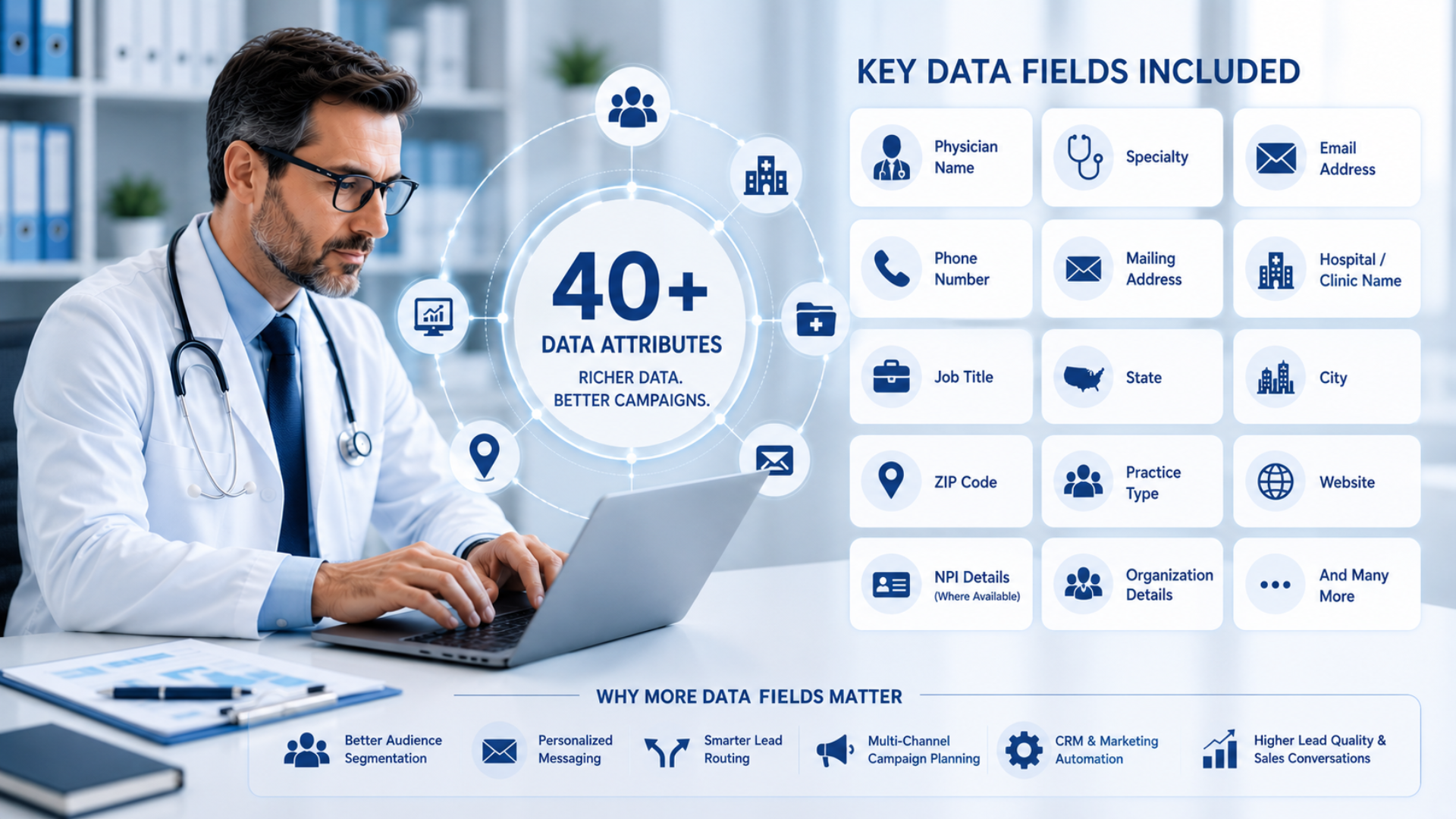
40+ attributes including NPI where available, SIC and NAICS codes |
Contact and firmographic fields, technographics, intent signals |
|
Data verification |
Seven-tier AI and manual process; 95% stated accuracy, 85%+ stated deliverability |
Seven-step email verification; 98% accuracy on its data page, 91% in its help center; under 1% invalid direct phone numbers |
|
Refresh cadence |
Revalidated every 45 days; weekly to quarterly cycles on contract |
150M contacts refreshed monthly; buying intent signals captured weekly |
|
Delivery model |
Custom dataset scoped to your brief, with counts and a sample first |
Self-service search with credit-metered exports |
|
Delivery formats |
CSV, XLS, JSON via API, or S3 bucket |
In-platform lists, CSV export, CRM sync, enrichment API |
|
Prospecting and outreach tools |
Data only; you use your own CRM and sending stack |
Sequences, dialer, scheduler, conversation intelligence, workflows, scoring |
|
CRM compatibility |
CRM-ready files named for Salesforce, HubSpot, Zoho and Dynamics import; no native sync published |
Salesforce, HubSpot, Pipedrive, Dynamics, Zoho, Outreach, Salesloft, Marketo, Zapier |
|
Pricing model |
Quote-based per requirement; no public price list |
Free tier, then $49 to $119 per user per month on annual billing; Organization needs three seats |
|
Compliance claims |
States GDPR, CAN-SPAM and ACMA adherence; permission-based sourcing with suppression and opt-out |
ISO/IEC 27001 and SOC 2 Type 2; GDPR, CCPA, CPRA and EU-US DPF listed on its trust center |
|
Best choice when |
You need a healthcare audience built to specification with clinical-level fields |
You need multi-industry prospecting with outreach tooling included |
What Is MedicoLeads?
MedicoLeads is a B2B healthcare data provider founded in 2016. Its published healthcare email list covers more than 14 million contacts globally, including over 6.2 million in the United States across 170-plus countries, organized by profession and facility type rather than by generic industry code.
Segments include physician contact data, nurses, dentists, pharmacists, surgeons, hospital contacts and medical device manufacturers. You describe an audience, review counts and a sample, then receive the dataset as a file.
What Is Apollo.io?
Apollo.io describes itself on its homepage as “the AI sales platform for smarter, faster revenue growth.” It pairs a B2B contact database with sales engagement tooling in one subscription, publishing more than 240 million contacts and 30 million companies searchable with over 65 filters.
Alongside data it bundles sequences, a dialer, a meeting scheduler, conversation intelligence, deal management, enrichment, workflow automation and lead scoring. It also runs dedicated physician and medical database pages, so healthcare targeting is a documented use case.
MedicoLeads vs Apollo.io: Key Differences
The two products solve different halves of the same problem.
- Data model. MedicoLeads structures records around healthcare, making specialty, license, practice type and facility category standard fields. Apollo uses generic business attributes with industry classification layered on.
- Buying motion. MedicoLeads is scoped and quoted per project. Apollo is self-service and credit-metered.
- Field depth. MedicoLeads publishes NPI, license number and state, and bed size. Apollo’s search filter glossary documents no NPI, license or specialty filter, though its physician page markets specialty filtering.
Healthcare Data and Audience Coverage
Apollo’s database is far larger overall, but size across every industry does not translate into usable healthcare records.
MedicoLeads publishes counts per segment, which makes coverage checkable before you buy: 1 million-plus physicians globally, 2 million-plus nurses, 740,000-plus hospital contacts, 653,000-plus medical device manufacturer contacts, 220,000-plus healthcare decision-makers, 214,000-plus dentists and 197,000-plus pharmacists. Apollo publishes no healthcare-specific counts.
Test both the same way: define one specialty in one state and compare the count against the clinicians you expect there.
Targeting and Segmentation Capabilities
Segmentation is where the two diverge most.
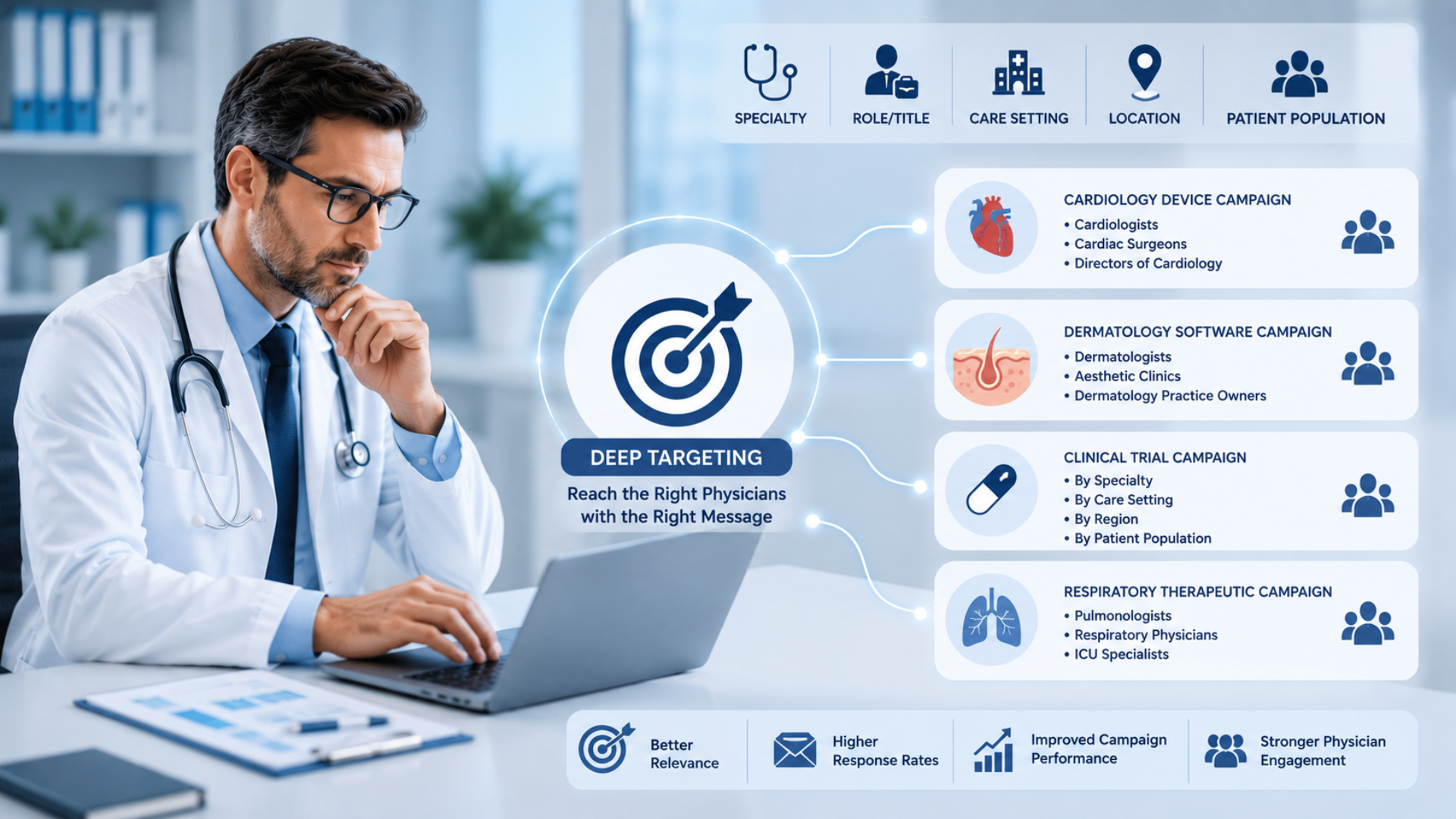
MedicoLeads advertises segmentation by specialty and subspecialty, license number and state, practice type, facility type, hospital bed size, geography, revenue and employee size, SIC and NAICS codes, and NPI on physician records.
Apollo’s documented filters cover job title, industry and keywords, location, headcount, revenue, installed technologies, buying intent across more than 15,000 topics, job postings, funding and lookalikes.
Both segment geographically to country, region and city. The real difference is clinical granularity: “interventional cardiologists in Texas at hospitals above 300 beds” maps onto a healthcare-structured database, while “VP of Revenue Cycle at health systems running a named EHR” maps onto Apollo’s title filters.
Data Verification and Contact Quality
MedicoLeads publishes a seven-tier verification process combining SMTP checks, AI validation and manual review, a stated 95% accuracy rate, deliverability above 85%, and revalidation every 45 days. The individual tiers are not itemized on its site, so ask for them in writing.
Apollo documents a seven-step email verification process, reports refreshing 150 million contacts monthly, and refunds a credit when a verified email bounces within 30 days. Its published accuracy depends on the page: the product data page states 98%, its help center 91%.
Treat these as vendor claims measured by different methods, not comparable scores. Request a sample from each and measure your own bounce rate, as this guide to healthcare contact data best practices sets out.
Prospecting, Sales Intelligence, and Outreach Features
Apollo is clearly stronger here. It bundles multi-step sequences across email, calls and LinkedIn tasks, a dialer with recording and transcription, a meeting scheduler with lead routing, conversation intelligence, lead scoring, workflow automation, a Chrome extension and an enrichment API, plus native integrations with Salesforce, HubSpot, Pipedrive, Dynamics, Zoho, Outreach, Salesloft, Marketo and Zapier. Power, parallel and international dialing need a separate Advanced Dialer add-on.
MedicoLeads supplies data rather than a sending platform. Files arrive as CSV, XLS, JSON via API or into an S3 bucket, with Salesforce, HubSpot, Zoho CRM and Dynamics named as import targets. That is file compatibility, not live sync, so confirm field mapping before ordering.
A team with no engagement stack saves real money on Apollo’s bundling; a team already running Salesforce with a sequencing tool duplicates much of it.
MedicoLeads vs Apollo.io for Healthcare Marketing
Fit depends on which healthcare job you are doing.
- Healthcare marketers running specialty campaigns need clinical-level segmentation, since a message written for oncologists performs poorly elsewhere.
- Medical device companies need territory-aligned files by geography and site of care, covering clinicians and procurement.
- Healthcare SaaS providers selling to hospital CIOs suit Apollo’s title and technographic filters; MedicoLeads publishes an EHR software contact list for that audience.
- Recruiters and staffing firms need license state and specialty, closer to a dataset like this verified nurse contact list.
- Pharma teams need NPI-linked records to deduplicate against files they own.
- Agencies want per-client custom builds, not shared seats.
For ABM, Apollo’s account model keys on company domains, which can fragment a health system with facilities on mixed domains. A file scoped to a named hospital network handles that, as this guide to reaching hospital procurement decision-makers shows.
When Should You Choose MedicoLeads?
MedicoLeads is the better fit when any of these apply.
- Your audience is defined clinically: specialty, license state, facility type or bed size.
- You need NPI, license or facility attributes in the file itself.
- You want counts and a sample before committing, not metered credits.
- You already own a CRM and sending stack and need only data.
- You need a suppression list deduplicated before delivery.
- You target healthcare audiences outside the United States.
When Should You Choose Apollo.io?
Apollo.io is the better fit when any of these apply.
- You prospect across several industries, not healthcare alone.
- You want to search, enrich and send from one platform.
- Your healthcare targeting is title-led: CIOs, CFOs, IT directors, revenue cycle leaders.
- You want published pricing and self-service onboarding.
- Buying intent, job postings and technographics matter to your qualification model.
- You need native CRM sync and a browser extension.
MedicoLeads vs Apollo.io: Which Is Right for Your Business?
There is no universal winner. The decision turns on one question: is your constraint the audience definition, or the workflow?
If you cannot describe your target without clinical vocabulary, a specialist gets you a usable file faster, while a broad platform spends credits on records you discard. If your audience is describable by job title and company size, and your team lacks sequencing tools, Apollo delivers more workflow for the money. The roundup of healthcare data providers in the US helps if you are weighing more vendors.
Either way, evaluate both the same way: request a sample against identical criteria, compare counts, and measure bounce rates before scaling.
One compliance note: B2B outreach to healthcare professionals at work is generally governed by rules such as CAN-SPAM, not by HIPAA, which covers protected health information held by covered entities. This is general information, not legal advice.
Looking for a Better Alternative?

Frequently Asked Questions
Is MedicoLeads a good Apollo.io alternative for healthcare campaigns?
It can be, when the requirement is healthcare-specific contact data rather than an all-in-one prospecting platform. MedicoLeads segments healthcare professionals, facilities and executives by specialty, license, role and location, then delivers a file scoped to your brief. It does not replace Apollo’s sequencing, dialer or CRM sync, so most teams keep those and change only the data source.
Can I request a sample before buying a healthcare contact database?
Yes. MedicoLeads states you can request a custom sample segment to review accuracy, format and relevance before ordering, and its healthcare contact database page shows the field layout a sample uses. Apollo offers a free tier. Ask for samples drawn from your actual criteria, not a generic file.
Does Apollo.io include NPI numbers or medical license data?
Apollo’s published search filter glossary documents no NPI, medical license or specialty taxonomy filter, and its physician database page does not mention NPI. MedicoLeads states NPI is included on physician records and lists license number and state among its fields. Confirm current availability with each vendor.
How much do MedicoLeads and Apollo.io cost?
Apollo publishes annual-billing rates of $49 per user per month for Basic, $79 for Professional and $119 for Organization, which carries a three-seat minimum, alongside a free tier. Plan credits do not roll over between billing cycles. MedicoLeads publishes no price list and quotes per requirement, since cost tracks record volume, segmentation depth and delivery format. Check the Apollo pricing page for current figures.
Can MedicoLeads build a custom healthcare database for my specialty and territory?
Yes. MedicoLeads states its team builds each list around your ideal customer profile, filtering by job title, specialty, practice type, location and organization size, with no fixed minimum order. It also states a custom healthcare database can be scoped around individual subspecialties, and that a suppression list can be deduplicated against new records before delivery.
What data fields and delivery formats does MedicoLeads provide?
MedicoLeads publishes 40-plus data attributes, including verified email, phone, job title and specialty, postal address, organization name, website, license number and state, practice type, hospital bed size, SIC and NAICS codes, and NPI on physician records. Files arrive as CSV or XLS, as JSON via API, or into an S3 bucket, with a stated turnaround of three to five business days.
Is it legal to email physicians and healthcare decision-makers?
Business-to-business email to healthcare professionals at work is generally governed by commercial email law rather than HIPAA. In the United States that means CAN-SPAM requirements: accurate headers, honest subject lines, a valid postal address and a working opt-out. Other jurisdictions apply stricter consent rules, including GDPR and CASL. This is general information, not legal advice.
How often should healthcare contact data be refreshed?
Clinician records decay quickly, because roles, hospital affiliations and practice locations change often. MedicoLeads states it revalidates its master database every 45 days and offers weekly, monthly or quarterly refresh cycles on contract. Apollo reports refreshing 150 million contacts monthly. Ask either vendor whether re-verification is included.